Our story, founders + editors, and frequently asked questions.
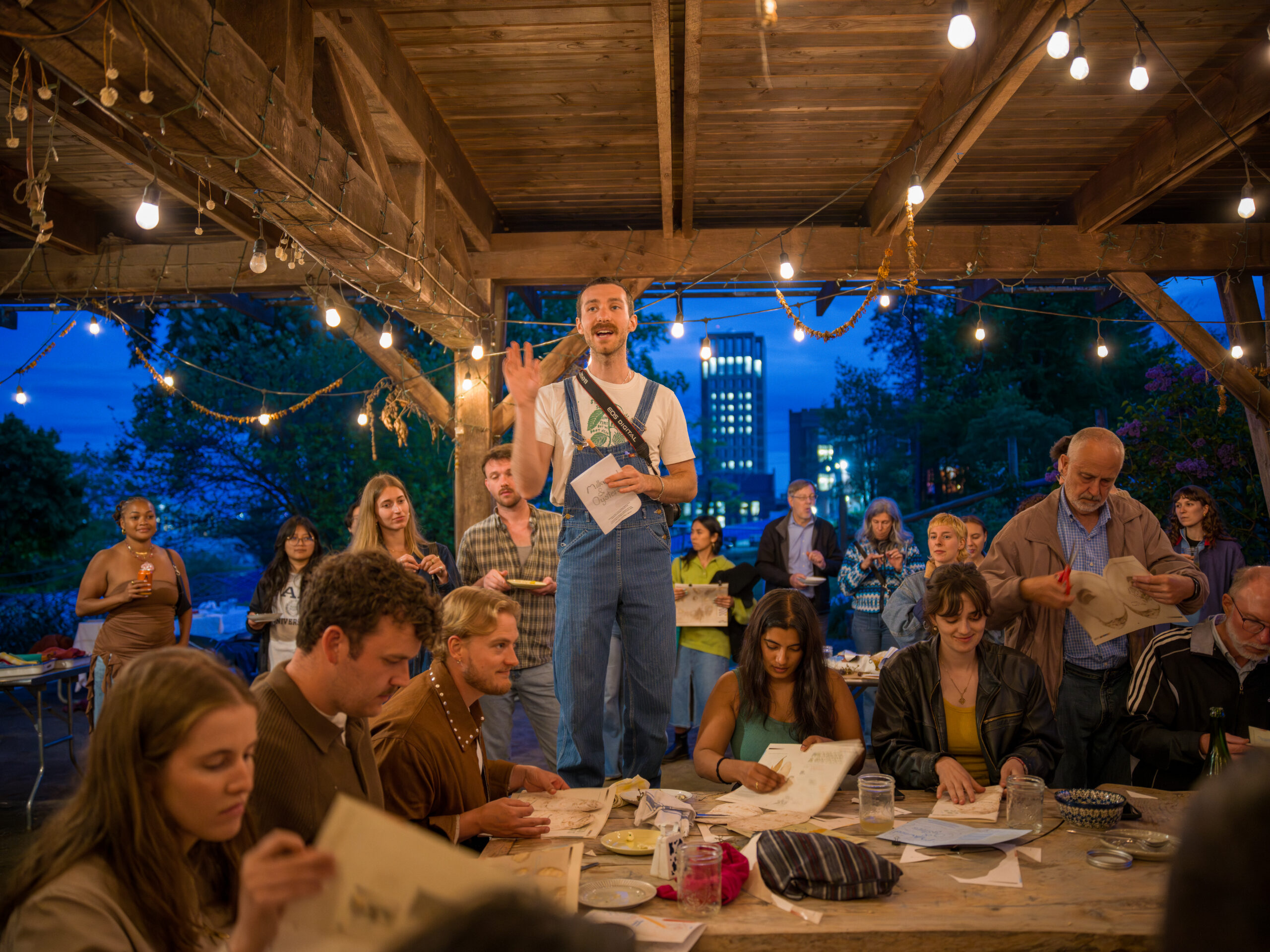
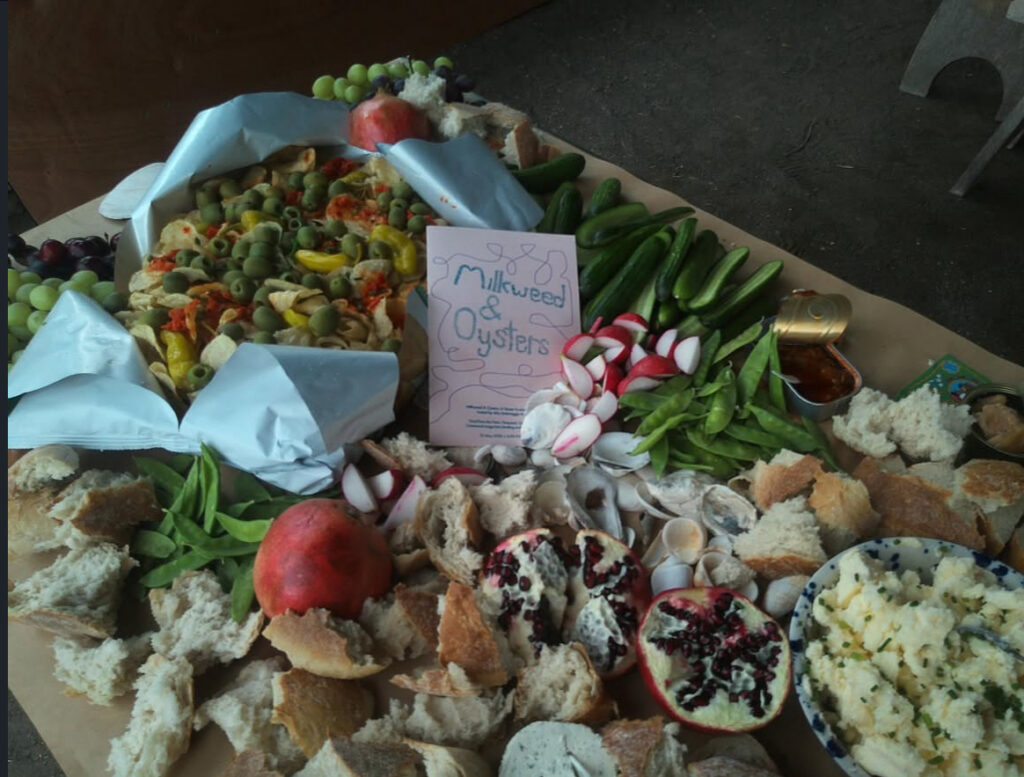
The Story of Milkweed & Oysters
Like tide pools or warm summer wind, everything that is meant to will eventually swirl together. We met in the fall of 2024 after moving to New Haven from Chicago and Ithaca for a master’s program, and quickly entered each other’s orbit—through coursework, queer community, and a devotion (!) to queer ecology.
Milkweed & Oysters was born from: a house party, a porch, a final paper, and snail mail sent from Ithaca, NY to Beaufort, SC.
Last year, Mia hosted a Mermaid and Fisherman-themed party. Brandon, in a secondhand light blue leather skirt and shimmery pink top, swam through the streets to get there; Mia wore waders. Weeks later, we sat on Mia’s porch – on robin’s egg blue ground, coffee in wide-mouth jars – and talked about water. Brandon wrote a paper titled but what if, we grew gills: a merfolk’s guide to queering climate adaptation & trans/formation. Mia was cited in it. We talked about how in large bodies of water, we get close, congregating instead of dispersing.
That summer, Brandon returned upstate to their queer restorative ecology site, Marshy Garden, while Mia worked in South Carolina among Spanish Moss and Cicadas. A year later, we came back together, and Milkweed & Oysters surfaced.
Queer Ecology lives in the words and art of queer people everywhere. These micro-relations with species, organisms, and so-called “inanimate” beings have kept our communities afloat through ongoing sociopolitical hardship. We gather, we collect, we celebrate.
This project is a queer love note, not only between Mia and Brandon, but with our kin species: milkweed, the native plant that sustains monarchs; and oysters, companions for millions of years, tracing our shores and sustaining us in return. Perpetual lovers and friends. Both pods cradle little lives, allowing sand and seed to slip through its cracks like whispers.
Milkweed & Oysters, conceptually, is our collective pod: of community, creation. It is our attempt to give back to the pods that grew us.
We welcome you into our pod, and we thank you wholeheartedly for reading.
With a smooch,
Mia + Brandon
Who are Mia and Brandon?
Mia Ambroiggio has eight years of experience publishing writing: from writing on climate and justice for the Loyola Phoenix, to producing a weekly column in the South Portland Sentry (Portland Press Herald), to writing for The Overstory, Yale Forest School’s publication of forest-centric news. In academic endeavors, Mia examines community and cultural cohesion within disaster and coastal resilience landscapes.
You can reach Mia here:
Brandon Hoak has self-published one book and one zine: Slow Summer (2025), on queer restorative ecology; and Queer Belongings (2025) a zine produced in Riso-graph and shown at the “Queer Visions, Queer Voices” exhibition in Ithaca, NY. Brandon has also served as the design editor to the magazine Understory (2022) on Indigenous and non-Indigenous relationship to Land, as well as the co-editor of Yale’s SAGE Magazine.
You can reach Brandon here:
Frequently Asked Questions
Where was Milkweed & Oysters printed?
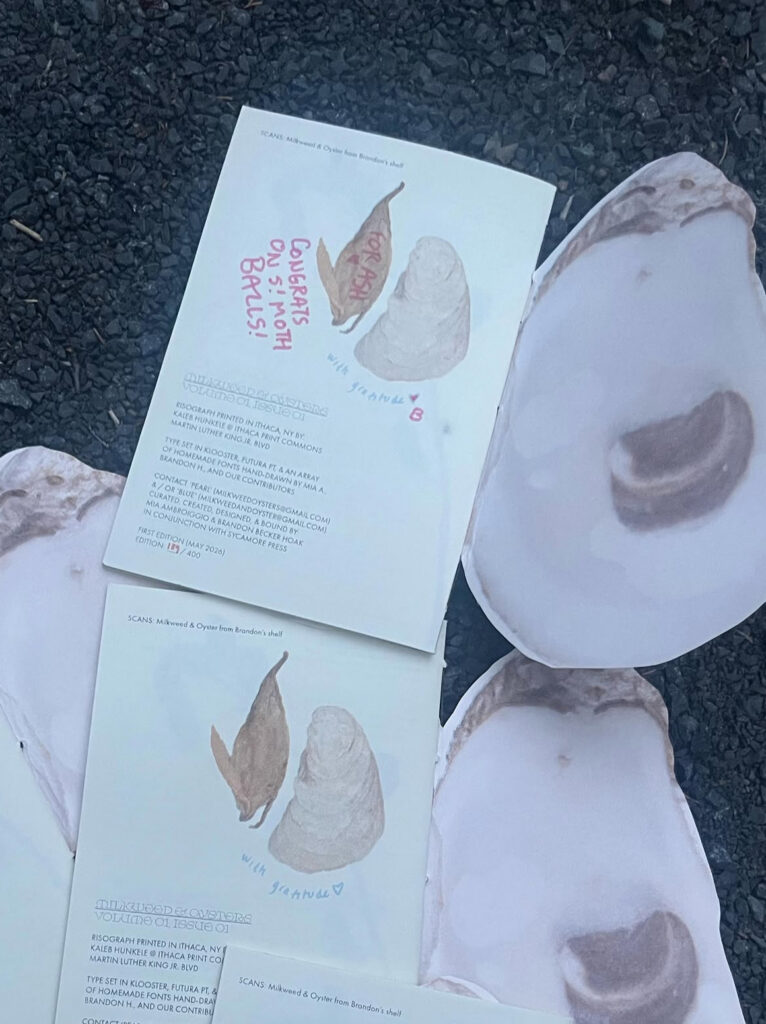
The magazine was printed in Ithaca, NY by Kaleb Hunkele through the Ithaca Print Commons.
These colors are really unique… what is the printing method?
The magazine was printed using a Risograph machine, which works with special colored inks, many based with soy. It has long been used by artists and comics for its special luster, expediency, and user-friendly machine interface.
How many copies were made?
Our ‘First Edition’ of this magazine amounts to 400. Each copy has been hand-numbered – you can see what special number you have on the back!
Why the name Milkweed & Oysters?
Brandon is a gardener of native plants, and has long loved all varieties of Milkweed, the host species to the Monarch caterpillar and many other beautiful fuzzies & buzzies! Mia grew up shucking and slurping – which has brought her to Louisiana, Maine, and more – and has a special devotion to oysters: for ritual, for resilience, for their role as a connector between people + coasts.
How many contributors partook in the first issue?
We had 18 – one of Brandon’s favorite numbers! Some from Yale, some from afar!
Are all the contributors queer?
No, but majority are! Our submissions are inclusive of everyone who feels called to the theme, and wants to join us in ~queering~ ecology.